
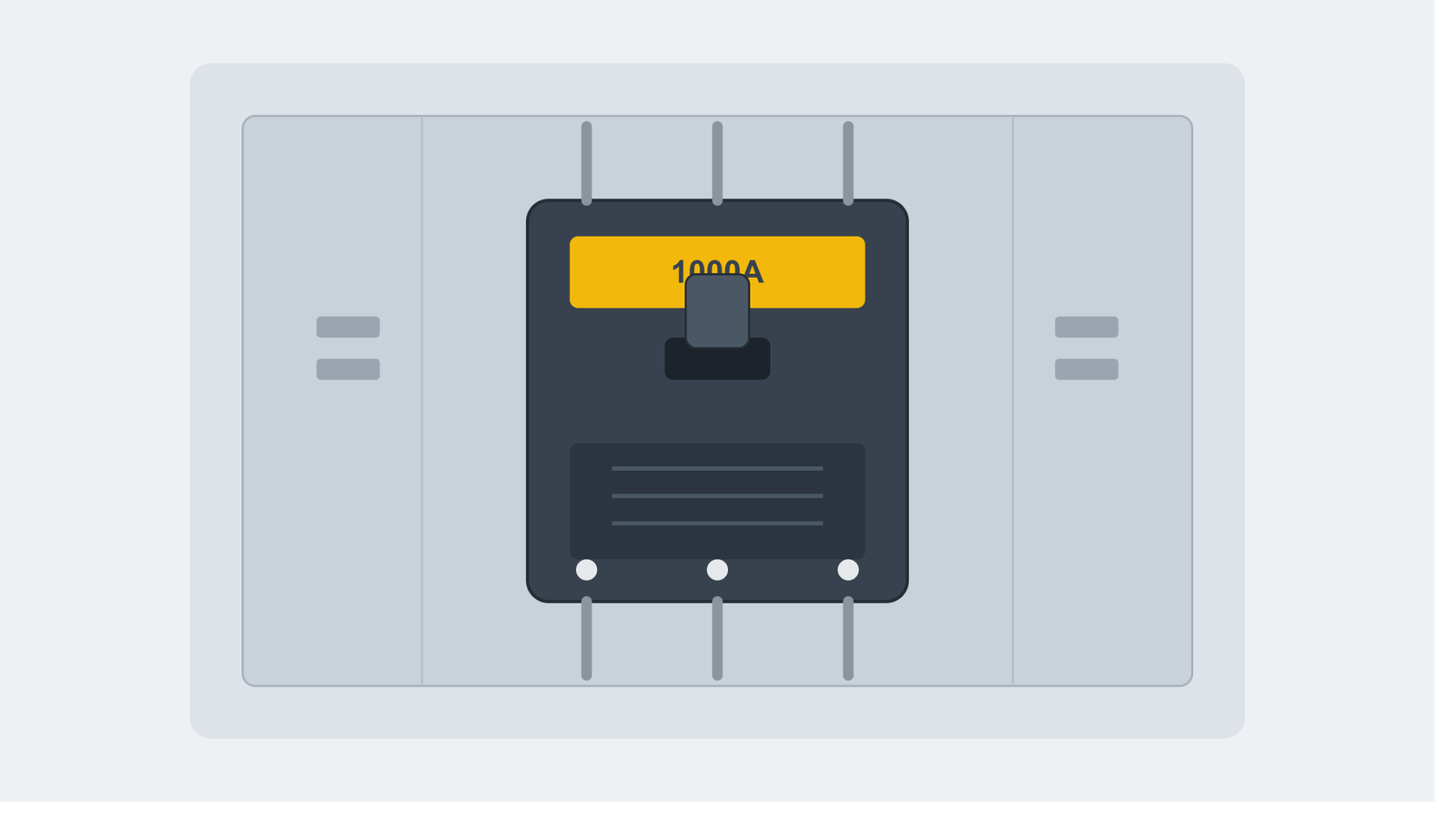
If you work in electrical maintenance, panel building, or industrial procurement in Singapore, chances are you’ve specified or replaced a Molded Case Circuit Breaker (MCCB) at some point. This guide breaks down what an MCCB is, how it differs from other protective devices, and what to check before you buy — whether you’re maintaining existing equipment or specifying a new panel.
What Is an MCCB?
A Molded Case Circuit Breaker (MCCB) is a protective device that automatically interrupts electrical current when it detects an overload or short circuit. Unlike a fuse, which must be physically replaced after it blows, an MCCB can simply be reset and reused — making it the standard choice for protecting motors, feeders, and distribution boards in industrial and commercial installations.
MCCBs sit in a power range between miniature circuit breakers (MCBs) and larger air circuit breakers (ACBs), typically covering current ratings from around 16A up to 2500A or more, depending on the frame size.
MCCB vs MCB vs ACB: What’s the Difference?
| Feature | MCB | MCCB | ACB |
|---|---|---|---|
| Current Rating | Up to 125A | 16A–2500A+ | 800A–6300A+ |
| Adjustable Trip Settings | No | Often yes | Yes |
| Typical Application | Lighting, small circuits | Motors, feeders, distribution | Main incomers, generators |
| Breaking Capacity | Low | Medium–High | Very High |
If you’re protecting a large motor, a sub-distribution board, or industrial machinery, an MCCB is almost always the right category to specify.
Key Specifications to Check Before Ordering
When sourcing or replacing an MCCB, don’t just match the current rating — these five specs matter just as much:
- Rated Current (In): The continuous current the breaker can carry without tripping.
- Breaking Capacity (Icu/Ics): How much fault current the breaker can safely interrupt. This is critical for short-circuit protection and often overlooked when swapping brands.
- Number of Poles: 3P (three-phase) or 4P (three-phase + neutral), depending on your system.
- Trip Unit Type: Thermal-magnetic (fixed) vs electronic (adjustable). Electronic trip units allow fine-tuning for motor protection and selective coordination.
- Frame Size: Determines physical dimensions and accessory compatibility (auxiliary contacts, shunt trips, motor operators).
Common Reasons MCCBs Need Replacing
- Nuisance tripping due to aging thermal elements or incorrect trip settings
- Physical damage from fault events or environmental exposure (common in marine and coastal installations)
- Obsolescence — older breaker models get discontinued, and exact replacements become hard to find
- Upgrades — panel modifications requiring a different breaking capacity or trip curve
Sourcing Tip: When the Exact Part Isn’t Available
In Singapore’s industrial and marine sectors, it’s common to need an exact replacement MCCB where the original brand or model has been discontinued. In these cases:
- Cross-reference by frame size, rated current, and breaking capacity first — not just the part number
- Confirm the mounting type (fixed vs plug-in vs withdrawable) matches your existing panel
- Check accessory compatibility if you’re reusing shunt trips, auxiliary contacts, or motor operators from the old unit
This is often where a sourcing partner adds the most value — pulling cross-reference data across brands (Schneider, Telemecanique, and others) and finding stock or fast lead times when the exact original part number is no longer produced.
Final Thoughts
MCCBs are a small part of a panel by cost, but a critical one for safety and uptime. Getting the specification right — not just the current rating, but breaking capacity, trip type, and frame compatibility — is what prevents nuisance trips, safety incidents, and costly downtime.
If you’re trying to identify, cross-reference, or source a specific MCCB and can’t find stock through your usual channels, feel free to reach out — we specialize in fast turnaround sourcing for exactly these situations.
Have a specific MCCB part number you need help identifying or sourcing? Contact us with the part number and we’ll get back to you with options.
